 Mon-Fri: 8:00AM-5:30PM
 1125 17th Ave Santa Cruz, CA 95062


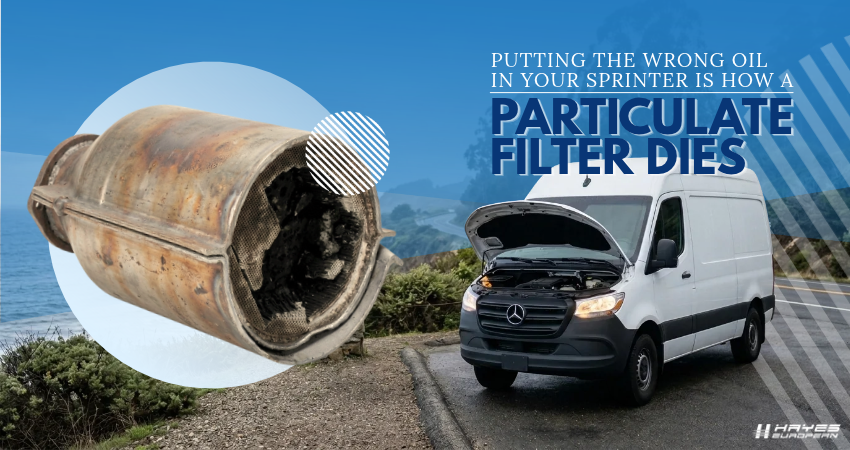
Picture two jugs of 5W-30 diesel oil on a parts counter. One of them says it meets a Mercedes approval number and costs noticeably more. The other is a well-known brand, correct viscosity, good reputation, and cheaper. For almost any gasoline engine the cheaper jug would be a reasonable call.
On a Sprinter, it is not, and the reason has nothing to do with lubrication. It is about what the oil leaves behind after it burns.
Quick Summary: Key Takeaways
- Viscosity is the easy half: 5W-30 on the label tells you nothing about whether the oil suits your van.
- Ash is the issue: the particulate filter collects what oil leaves behind, and ordinary diesel oil leaves more of it.
- Ash does not burn off: regeneration clears soot, and the ash stays in the filter permanently.
- The approval number is the whole point: your service booklet lists an MB-Approval sheet, and that sheet is what you match.
Every engine burns a little oil, and the filter keeps the residue
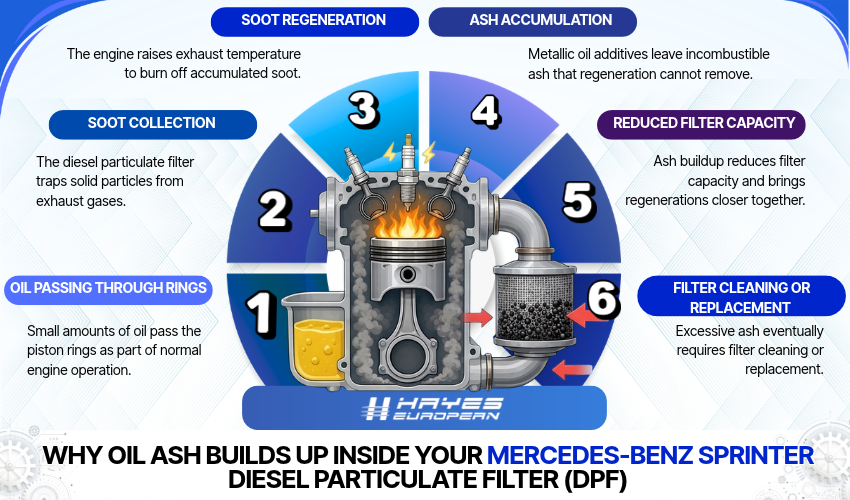
Every engine lets a small amount of oil past the piston rings, and the design allows for it. In a gasoline engine that residue leaves through the tailpipe and nobody thinks about it. In a modern diesel it runs into a particulate filter whose job is to catch solids.
Soot is the part the system knows how to deal with. When the filter loads up, the engine management raises exhaust temperature and burns the soot off, and the filter goes back to being mostly empty. That cycle can run for the life of the van.
Ash is the part it cannot deal with. The metallic additives in engine oil, the detergents and anti-wear compounds, leave an incombustible residue when they burn. Regeneration does not touch it. It accumulates, filter capacity shrinks, regenerations come closer together, and eventually the filter needs cleaning or replacement well before it should have.
Low-ash oil is a measurable specification
Oils formulated for engines with particulate filters are built with a reduced additive load, so they carry their own approvals instead of sitting on the same shelf as everything else. The trade-off is real chemistry: fewer ash-forming additives, reformulated to keep the same protection, and that is part of why they cost more.
Mercedes handles this by publishing approval sheet numbers, and your Sprinter’s service literature names the one that applies to your engine. An oil either carries that approval printed on the container or it does not, and no amount of matching the viscosity grade substitutes for it. A jug labeled for heavy-duty diesel service tells you the kind of engine it was blended for. It does not tell you whether Mercedes signed it off for yours.
Your van also keeps a record of how it has been treated. Scan data on these engines reports distance since the last successful regeneration and an estimate of how loaded the filter is, and reading those two figures alongside the service history tells us more about the van’s future than any single measurement on the bench. A van showing short gaps between regenerations and a high loading estimate has usually been fed the wrong oil, driven too short, or both.
Short runs around the Monterey Bay make it worse
Ash loading is a slow problem. Incomplete regeneration is a fast one, and the two compound.
A van doing deliveries between Santa Cruz, Capitola and Soquel spends a lot of its day below the exhaust temperature a regeneration needs, so cycles get interrupted partway through. Soot that should have burned stays in the filter alongside the ash, back pressure climbs, and the engine management starts running regenerations more often, which in turn puts more fuel past the rings and more oil dilution into the sump.
Hauling over Highway 17 fixes part of that, because a sustained climb is exactly the load that gets the exhaust hot and keeps it there. If your van rarely leaves town, plan a long run on purpose every few weeks.
The California wrinkle most van owners forget
This is not only a repair-bill question here. The Bureau of Automotive Repair requires a Smog Check for diesel vehicles of model year 1998 and newer, and the inspection reads the van’s onboard diagnostic system. A particulate filter that has loaded up past the point where the engine management is satisfied will have set a fault, and a fault that is commanding the dash light on is a failed inspection before anyone looks at the tailpipe.
So the cheap jug of oil can turn into a filter, a diagnostic, and a registration problem arriving in the same month. Matching the approval number costs a few dollars a service.
The Approval Number Takes a Minute to Confirm
Service records help, and the van on its own is enough. We confirm the approval your engine calls for, read the filter’s recent behavior off the scan tool, and recommend nothing before those two things are known.
Hayes European — 1125 17th Ave, Santa Cruz, CA 95062
santacruzeuropeanauto.com
→ Book an appointment online