



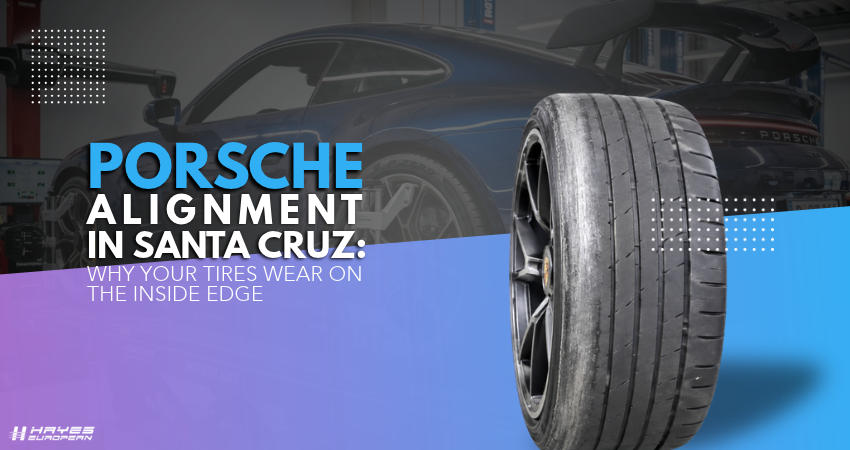
Run your hand along the inside shoulder of a front tire. On a lot of 911s, Caymans and Macans, that’s where the rubber disappears first, and you can’t see it from the curb. A Porsche alignment that has drifted is the usual reason. Porsche builds its cars with the wheels tilted in at the top, which loads the inner edge, and one hard pothole can knock toe out on top of that. Rain is coming. The Central Coast’s wet months break up Highway 17 and the side streets around Santa Cruz, so get it checked before the holiday drives.
Quick Summary: Key Takeaways
- Inner-edge wear is an alignment clue: factory camber loads the inside shoulder, and toe that’s out makes it scrub.
- Potholes change toe: one sharp hit is enough, and no warning light comes on.
- Worn parts won’t hold settings: loose bushings and joints come first.
Inside-Edge Tire Wear Starts With Porsche’s Geometry
Most Porsches are set up with negative camber, meaning the top of each wheel leans in toward the car. That’s deliberate. In a corner the body rolls, the tire stands up, and more rubber meets the road just when you need it.
The trade-off shows up on straight roads. Driving to work on Soquel Drive puts more load on the inner shoulder than the outer one, every mile, so some extra inner wear is normal on a Porsche. An inside shoulder worn to the cords while the center tread looks fine is not normal, and it means camber has gone past the factory range, or toe has drifted and the tire is being dragged sideways.
Camber and Toe Do Different Kinds of Damage
Camber is the tilt of the wheel. Toe is whether the fronts of the tires point in or out, and each one leaves its own pattern on the tread, which is why a careful look at the worn tire tells you which angle has gone wrong.
Too much negative camber wears a smooth band along the inside edge. Toe that’s out wears faster and rougher. Drag your palm across the tread from outside to inside and back, and a toe problem often feels like feathered edges, smooth one way and sharp the other. Toe is the expensive one, because a small error scrubs the tire on every rotation, and on a 911 running staggered tires you can’t rotate the fronts to the rear to spread the damage around.
People mix up the two services. Balancing spreads weight evenly around the wheel so it doesn’t shake, while alignment sets the angles at which the wheel meets the road.
Winter Rain Opens the Potholes That Knock Toe Out
The Santa Cruz area gets most of its rain between November and March, and that’s when the pavement breaks up. Western Regional Climate Center records for the Santa Cruz station, covering 1893 to 2016, show an average of 6.14 inches of rain in January and 0.06 inches in July.
Water gets under the asphalt, traffic pounds it, and holes appear. One impact on Highway 17 near Pasatiempo, or a flooded dip above Scotts Valley you didn’t see until too late, can bend a tie rod or shift a rear toe link. Nothing lights up on the dash. The steering wheel may sit slightly off center. Or it may not.
Worn Suspension Parts Make an Alignment Pointless
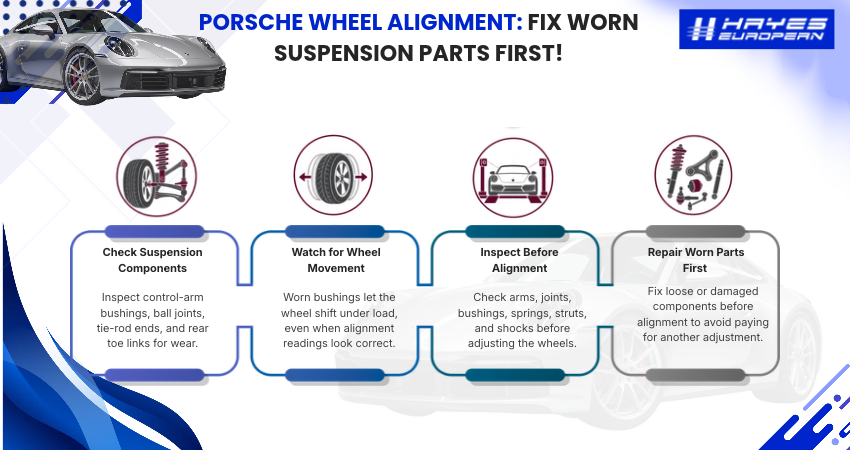
An alignment only lasts if the parts holding the wheel are tight, so the suspension gets checked first. Control-arm bushings, ball joints, tie-rod ends and the rear toe links on a 911 or Boxster all wear, and a tired bushing lets the wheel shift under load even when the numbers look perfect on the rack.
So the order matters. Hayes European‘s suspension inspection covers the arms, joints, bushings, springs, struts and shocks. Sort out whatever is loose before the wheels are set, because aligning a car with a split bushing means paying for a second alignment once the angles wander off again.
When to Book a Porsche Alignment
Book a Porsche 911 alignment, or one for a Cayman or Macan, whenever new tires go on, after any hard pothole or curb strike, and after suspension work such as control arms or tie rods.
A pull to one side, a steering wheel that isn’t centered on a straight road, or a tire that squeals at low speed in a parking lot all point the same way. Each one means a check. Inner-edge wear also hides well, and the car can feel fine while one tire loses half its life, so check the inside shoulders every month or two through the rainy season.
A shake at speed is a separate problem. If it survives a fresh balance, a bent wheel or a worn driveline part is the likelier cause, and either one can feel a lot like an alignment fault from behind the wheel.
Porsche Owners From Aptos, Capitola and Soquel
Hayes European has served Santa Cruz drivers since 1995, and wheel alignment is one of the services listed on its Porsche page. Capitola and Aptos are a few exits away on Highway 1.
The after-hours key drop is open around the clock. Leave the car in the lot, drop the key, and phone in what you’ve noticed, which is convenient for anyone commuting over the hill to San Jose.
Frequently Asked Questions
Q: Why are my Porsche tires wearing on the inside?
A: Porsches run negative camber, which loads the inner shoulder. Heavy inner wear usually means camber or toe has drifted out of range after a pothole or worn bushings.
Q: How often should a Porsche get an alignment?
A: Whenever new tires go on. Also after a hard pothole or curb impact, and after any steering or suspension repair.
Q: Can a pothole knock my Porsche out of alignment?
A: Yes. A sharp hit can bend a tie rod or shift a toe link, and the first sign is usually a crooked steering wheel or uneven tire wear rather than a light on the dash.
Where to Take a Porsche for Alignment in Santa Cruz
A phone photo of the worn shoulder helps, particularly if the tires have been rotated or replaced since you noticed it. Request a time through the appointment form on santacruzeuropeanauto.com, then show the photo at the counter at 1125 17th Ave, Santa Cruz, CA 95062, so the technician knows which corner to measure first.