



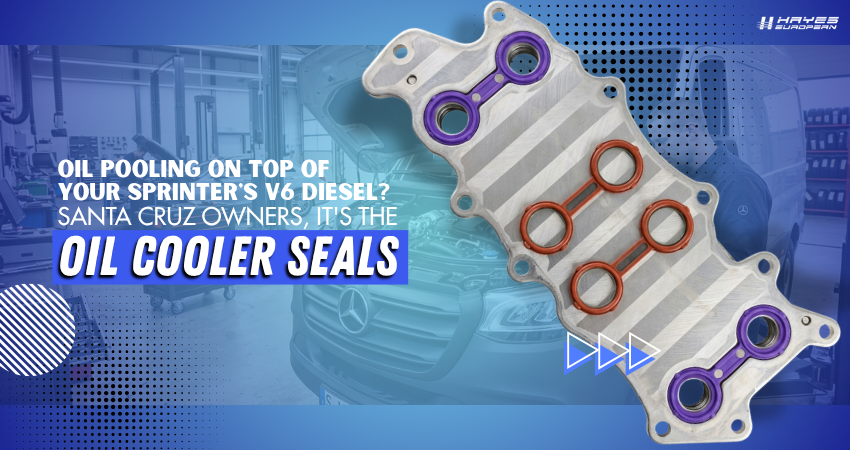
You open the hood of your Sprinter and there’s oil where oil shouldn’t be — collected in the valley between the cylinder banks, running down the back of the engine, sometimes dripping onto the bellhousing and burning off with that unmistakable smell. On the 3.0-liter V6 diesel, that’s almost always the oil cooler seals, and they sit under the intake, in the middle of the engine, where nothing is easy to reach.
Hayes European has serviced Dodge and Mercedes Sprinter vans — diesel and bio-diesel — in Santa Cruz since 1995. If your van works for a living hauling gear over Highway 1 or up to Watsonville, this is the leak worth catching before the wet season, because oil in that valley finds wiring, sensors and the transmission bellhousing on its way down.
Quick Summary: Key Takeaways
- Where it leaks: the oil cooler sits in the engine’s valley under the intake manifold, so its seals leak inward and downward rather than onto the ground.
- Which engines: the OM642 3.0 V6 CDI used in Sprinter vans from the 2007 model year on, in both Dodge and Mercedes-badged vans.
- The tell-tale signs: oil visible in the valley, oil down the rear of the block, a burning smell, and dropping oil level with no puddle underneath.
- It gets misdiagnosed: the same picture gets blamed on the rear main seal or the turbo drain, so where the oil starts matters more than where it ends.
- Do the related seals together: access is most of the labor, so the cooler seals, intake gaskets and turbo lines belong in one visit.
The oil cooler lives in the worst possible place
On the OM642 V6 the oil cooler bolts into the vee between the cylinder banks, sealed to the block with O-rings. Coolant runs through it. Oil runs around it.
To reach it you remove the intake manifold and everything on top of the engine, which is why the labor on a set of inexpensive seals surprises owners the first time. The seals themselves harden from constant heat cycling in a tight, hot space, and once one goes the oil has nowhere to fall but into the valley and then down the back of the block — so by the time you notice it, the whole rear of the engine is coated.
How to tell this leak from a rear main seal
Both end up dripping near the bellhousing. That’s the trap. The difference is where the oil is clean and where it’s dirty.
With a cooler seal leak, the valley on top of the engine is wet and the rear of the block is coated from above. With a rear main seal, the top of the engine is dry and oil is escaping from the crankshaft flange below. We degrease the engine and add UV dye before we quote either job, because on a van with 180,000 working miles both are plausible and only one is your actual problem.
Cool, damp autumn mornings make diesel leaks worse
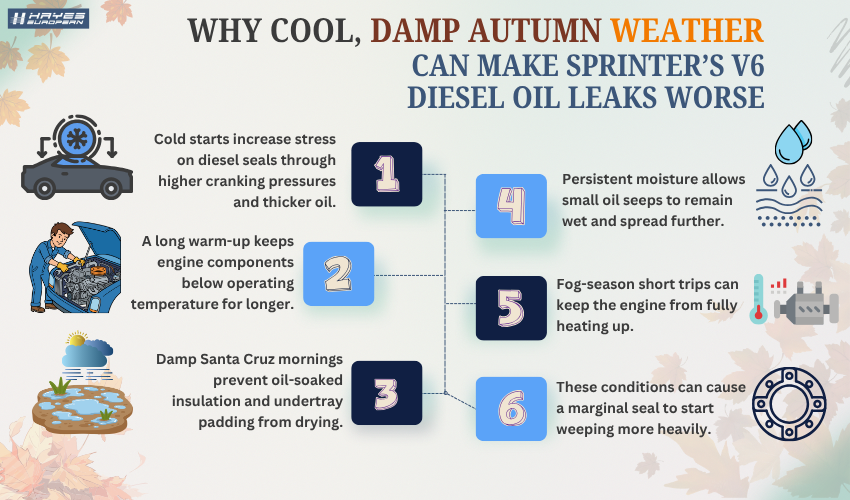
Cold starts are hard on diesel seals. Higher cranking pressures, thicker oil, and a long warm-up before anything in the engine reaches its operating temperature.
Santa Cruz mornings are damp rather than freezing, which changes the picture in one specific way: oil that has soaked into insulation and undertray padding doesn’t dry off, so a small seep stays wet and keeps spreading. Fog season also means more short trips with the engine never fully hot. That’s when a marginal seal starts weeping in earnest.
Fuel choice does not cause this, but it does deserve attention
Let’s clear something up. Bio-diesel doesn’t destroy oil cooler seals — heat and age do that — but blend awareness still matters on a working van.
B20 fuel contains 6% to 20% biodiesel, while B5 contains up to 5%, according to the U.S. Department of Energy’s Alternative Fuels Data Center. Higher blends can be harder on older fuel-system elastomers and encourage sludging if service intervals slip, so if you run bio-diesel we want to know the blend and see the van on a sensible schedule. We’ve worked on bio-diesel Sprinters for years. Tell us what you’re feeding it.
What the repair looks like on a Sprinter
The intake comes off, the cooler comes out, the seals get replaced, and everything gets cleaned before it goes back together. Straightforward work. Awkward access.
Because the top of the engine is already apart, we replace the intake manifold gaskets, inspect the turbo oil feed and drain lines, look at the glow plug harness and the injector seals, and clean the valley properly so any future leak is immediately visible. Then we run the van up to temperature and re-inspect. Our technicians are ASE certified, we use factory-grade tools, and there’s an after-hours key drop for owners whose vans can’t sit idle during business hours.
Frequently Asked Questions
Q: Why is there oil on top of my Sprinter engine?
A: On the 3.0 V6 diesel, oil collecting in the valley between the cylinder banks points at the oil cooler seals underneath the intake manifold. Oil from a higher leak can also drain there, so it needs to be traced properly rather than assumed.
Q: How much does a Sprinter oil cooler seal job cost?
A: The parts are modest. Labor is the bulk of it, because the intake and everything above the cooler has to come off. We quote after inspecting your van, and we’ll tell you what else is worth doing while access is open.
Q: Can I keep driving my Sprinter with an oil cooler seal leak?
A: For a short time, watching the level closely. But oil pooling on a hot engine is a fire risk, it degrades wiring insulation and sensor connectors, and the leak only grows. Get it looked at.
Q: Do you service both Dodge and Mercedes Sprinter vans?
A: Yes — both badges, diesel and bio-diesel, and we’ve been doing Sprinter work in Santa Cruz for years. Fleet vans and single owner-operators get the same attention.
Book Sprinter diesel service in Santa Cruz
Oil in the valley isn’t going to seal itself. Bring the van to 17th Avenue and let us find where it starts before the rainy season adds to the mess.
Hours: Mon–Fri 8:00 AM – 5:30 PM; Sat–Sun closed
Website: santacruzeuropeanauto.com