 Mon-Fri: 8:00AM-5:30PM
 1125 17th Ave Santa Cruz, CA 95062

Brake Fluid Flash
Express Brake Fluid Flush in Santa Cruz, CA
Brake fluid is one of the most consistently overlooked fluids in European vehicle maintenance, and it is also one of the most safety-critical. Unlike oil or coolant, brake fluid degrades not from mileage but from moisture absorption over time. It does not matter how few miles you have driven in the past two years. If your brake fluid has not been changed in that window, it has absorbed enough atmospheric moisture to meaningfully reduce its boiling point and compromise your braking system’s performance under hard use. Hayes European offers fast, same-day brake fluid flush service for every European brand we specialize in, open weekends, no appointment needed.
This is a service that most quick lube chains do not offer at all, and that many general shops perform incorrectly by not fully purging the old fluid from all four calipers. At our pit stop on 17th Ave, we do it right, with the correct fluid specification for your exact vehicle and a complete system flush from the reservoir through every corner of the car.
Why Brake Fluid Degrades and Why It Matters
Brake fluid is hygroscopic, meaning it actively absorbs moisture from the surrounding air through microscopic pathways in brake hoses, seals, and the reservoir cap. This is not a defect; it is a chemical property of the glycol-based fluid used by all European manufacturers. As the moisture content rises, the fluid’s boiling point drops. Fresh brake fluid boils at around 400 to 500 degrees Fahrenheit, depending on specification. Fluid with significant moisture contamination can boil at temperatures well below 300 degrees.
Why does that matter? Brake fluid boils inside your calipers when you brake hard. When it boils, it turns to gas. Gas is compressible; brake fluid is not. A brake pedal that suddenly goes soft or drops to the floor during heavy braking on a mountain descent or in a highway emergency stop is often due to brake fluid vaporizing from heat. Replacing the fluid every two years, regardless of mileage, eliminates that risk for a fraction of the cost of any repair it might otherwise prevent.
Santa Cruz’s coastal humidity accelerates moisture absorption in brake fluid compared to drier climates. We factor that in when assessing service intervals for cars that come to us from the coast versus the mountains.
What Is Included in Our Express Brake Fluid Flush
Most brake fluid flushes at Hayes European are completed in 30 to 45 minutes. It is one of the faster fluid services we offer and pairs efficiently with an oil change or filter service if you are due for multiple items in the same visit. Every brake fluid flush at Hayes European includes:
- Full system bleed starting at the reservoir and working through all four corners of the vehicle
- Removal of all old hygroscopic fluid from the master cylinder, brake lines, and all four calipers
- Refill with the correct brake fluid specification for your exact make and model
- Brake pedal feel check after the flush to confirm full system pressure and no air in the lines
- Visual inspection of brake hoses and caliper condition while the system is open
- Honest assessment of brake pad and rotor wear observed during the service
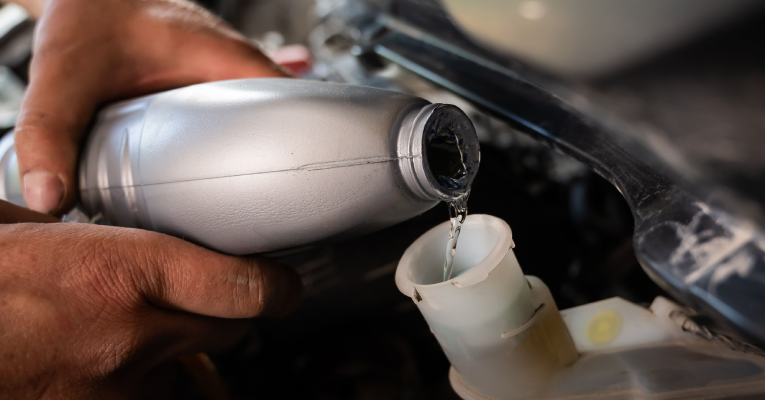
We use the correct fluid specification for every vehicle we service. Mercedes specifies DOT 4 Plus in most applications; Porsche and BMW specify their own high-performance DOT 4 Low Viscosity formulations; Volvo and Audi specify standard DOT 4; and Sprinter vans have their own commercial specification. Using the wrong fluid can damage seals and reduce system performance. We do not mix specifications.
Every Vehicle Brand We Service
Our express brake fluid flush service covers every European brand Hayes European specializes in:
Audi
BMW
Mercedes-Benz
Porsche
Mercedes Sprinter
Volkswagen
Volvo
Book Your Express Brake Fluid Flush in Santa Cruz
Hayes European has been maintaining the brake systems on Santa Cruz’s European cars since 1995. Drivers from Capitola, Soquel, Aptos, Scotts Valley, Watsonville, Monterey, Carmel, and across the Central Coast bring their cars to us specifically because they know we understand the difference between a proper full-system bleed and a half-completed top-off that leaves degraded fluid in the calipers. Located at 1125 17th Ave, Santa Cruz, CA 95062, we welcome walk-ins for express brake fluid flush service and are open on weekends when most European shops in the area are closed. Call us at 831-205-1159 to confirm availability or schedule ahead. Combine your brake fluid flush with an express oil change or spark plug replacement to handle multiple services in a single pit stop.
Frequently Asked Questions
How often should I flush my brake fluid?
Most European manufacturers recommend every two years, regardless of mileage. Mercedes, BMW, Porsche, and Audi all specify a time-based interval rather than a mileage-based one for this reason. If you are in a high-humidity coastal environment like Santa Cruz, the case for sticking to that interval is even stronger.
How do I know if my brake fluid needs replacing?
The most reliable way is to have it tested with a moisture content meter, which we do as part of every flush service. Visible signs that fluid is well overdue include a dark brown or black color in the reservoir rather than the light amber color of fresh fluid. A brake pedal that feels softer than it used to or requires more pressure for the same stopping force is also a sign of fluid degradation.
Is brake fluid flushing the same as bleeding the brakes?
They are related but not identical. Bleeding removes air from the brake lines and is typically done after a brake repair that opened the hydraulic system. A flush replaces all of the old fluid in the entire system with fresh fluid. A proper flush involves bleeding each corner of the car to ensure all old fluid is purged, which is why a full flush takes longer than a simple bleed.
Can I mix different brake fluid specifications?
Most DOT 4 fluids are technically compatible with each other in an emergency, but different European manufacturers specify different formulations for good reasons. Mixing a standard DOT 4 into a system that specifies a low-viscosity performance formulation will affect ABS and stability-control response times. We always use the correct specification and never mix fluids.
My brakes feel fine. Do I still need a fluid flush?
Yes. Brake fluid degradation does not produce noticeable symptoms until the system is under heavy heat load, at which point compromised fluid can cause brake fade or pedal loss at exactly the moment you need full braking performance. Flushing on schedule is the only way to ensure your system performs correctly when it matters most.